Solemn Witness
by Diana Merrifield
After nearly 24 hours of recovery from travel, our group began our solemn witness at the Memorial for the Murdered Jews of Europe.
The victims came from 18 different countries. But mostly of them from Poland and Russia.
A movement grew in the wake, and fear of what was to come from a reunited Germany to create a symbol of memory, but also a warning for the future. The monument was built in the space left behind when the Berlin Wall was dismantled. The Wall was, in fact, two walls with a guarded space between them. If people escaped through one wall, they risked death by East German sniper before making it to the second wall. This space was called the Death Zone, and aptly, this memorial is there.
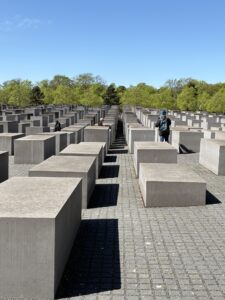
Designed by architect Peter Eisenman, the stark memorial remains controversial. Emma, our guide, explained that some Germans would have preferred a memorial that named Nazism‘s victims, but that so many names remain hidden to us that it would have never been complete. The designers struggled with how to make a lasting representation, to make “concrete” the scale of this international horror. The result is a sculptural representation in concrete, rows and rows of black rectangular monoliths, not unlike raised grave markers. As you are walking among and through them, they render for the visitor a darkness and heaviness, the meaninglessness of the incomprehensible scale of violence of the Shoah.
The memorial space represents a moment in German history, placed amidst the bustle of a burgeoning reunited international city. It demands to be confronted and encountered, and the intentional chaos invites many interpretations. The featureless stones can represent all the hope embodied in lives that were extinguished. The small cobblestones making up the ground under the monoliths can represent the millions of witnesses who supported the horror by their silence. The monoliths start shorter in stature, then build in undulating rows until they are overwhelming, taller than a human being encountering them. Like the killing system they represent, for which no meaning can be found. Except that the history has to be encountered, confronted, and processed by the people of a reunited Germany and a broken world. The design demands that the city stop for it.
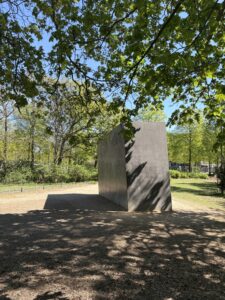
A short walk away, we visited the Memorial to the Persecuted Homosexuals under National Socialism. It is set within a forested shady park, a warren of rabbits played nearby, God’s creation bringing a welcome lightness.
Also constructed in black stone, it reflects the shared humanity of the other, much larger memorial, but the singular and tall, rectangular monument was designed purposely with its angles askew to show the individual character of people within the community.
Prior to 1935, gay activity had already been illegal between men. It had been built into the founding constitution of Germany in 1871, Paragraph 175 of the criminal code. The Third Reich radicalized it to remove the burden of proof of “homosexual activity”. A person could be arrested, even killed on a suspicion, on a glance. Gay men threatened the patriarchal order revered by the National Socialists.
Following the war, East Germany treated gay men with suspicion, and homosexuality remained illegal in West Germany. In fact, nazi documents that identified gay men were used by West Germany to continue the persecution of gay men. Homosexuality wasn’t to be legalized until the unification of Germany in 1989.
Our final stop this morning was the Memorial to the Victims of Nazi Euthanasia. A villa located at Tiergarten Strasse Number 4 was the site of a comprehensive euthanasia program in service to perfecting a master Aryan “race.”
Known as the “T4 action,” it is the precursor to the persecution of Jews and other “undesirable” populations. Adults and children with physical and mental disabilities, or chronic illness, were murdered on this site, often with the consent of their loved ones. It is the only memorial that is located on the site of the committed atrocities. It was only after locals grew uneasy and experienced discomfort within the sight and smells of the deception that the killing was moved out of Germany, from this park-like setting in Berlin.
The programs were operated by 100-200 staff members. The scale of killing is difficult to digest – 70,000 murders from 1939-1941 by gas and cremation, 90,000 after 1941 by starvation and lethal injection.
Our guide Emma told us that an influential bishop of Munster began to preach against the killings. Because of the rising awareness, the Nazi’s learned the operations needed to stay hidden from the German people, prompting the killing to be moved to Poland. Euthanasia is illegal in Germany.
As a Christian witness, I was especially disturbed by this memorial. How do we get from caring for the least of these to encouraging and industrializing their destruction?