“One begins by going into darkness”
by Marvin Daniel
Today was a remarkable day for those of us on the May term travel seminar, “The Shoah,” or the Holocaust, which began yesterday in Berlin.
We started by taking the underground to our first stop, which was the memorial to the murdered Jews of Europe, where we met our remarkable guide. She explained to us the construction of the monument on a piece of land that was originally in the “death strip” between East and West Berlin. After reunification, the site was selected as the place to commemorate the 6,000,000+ Jews who perished during the holocaust.
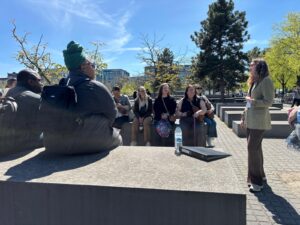
We learned that only 200,000 of the 6 million were actually from Germany, while the remainder were from other European countries, hence the memorial’s name. This large park, which was filled with rows and rows of granite blocks of various heights. Our guide explained that there is not one explanation for why this design was chosen from the many that were submitted.
One thing is clear: one begins by going into darkness and coming out on the other side of the Memorial into the light.
We proceeded from that memorial to a memorial to the homosexuals murdered by the National Socialists. At first, this appears to be a square granite cube, but in actuality, it is not a cube but an angular block of stone dedicated to the memory of those who might have lived life on a different angle. An angle that was considered unacceptable and not “straight” at the time, and for that they were murdered. We next walked to what is referred to as the T-4 Memorial. It is located in the Tiergarten and was where 70,000 basically “ undesirables” were murdered within the city limits of Berlin during the early years of the Nazi regime.
Stunning. Remarkable. Unforgettable.
We got back on the underground and proceeded to the Neue synagogue, which was built in 1866 and remained up until the early years of World War II, the most important Jewish House of worship in Berlin. It is home to one of the most important archives, documenting the history of Jews in Germany.
This synagogue was in continuous use until Passover services on March 30 of 1940. The story that we learned from our guide was that this synagogue symbolized how natural it was to be a German, a Berliner, and a Jew at the same time. This became an important congregation in the early years of liberal Judaism, which led to the American Reform movement.
All in all, it was simply a remarkable day for us to learn more about Jewish life in pre-war Berlin and about what has been done to memorialize it in Berlin and Germany. We were faced with beginning to acknowledge the lengths that the National Socialists went to eradicate these people and any history of them.