Lament
by Rev. Dorothee Tripodi
“You are a religious group,” our Auschwitz Birkenau tour guide observed, after I explained who we were and why we were at Auschwitz-Birkenau. “You will want to say prayers. There really are only two places where it is appropriate.” I assured him we would accept his guidance, and our prayers would be appropriate. Auschwitz I, on a holiday, was busy with visitors and many groups, though the mood grew more somber and reflective as we progressed thought the different buildings. It just did not seem right to pray, we did not want prayer as a Christian spectacle. We made it to Birkenau, and its places of mass destruction. We stood at the memorial’s graves created because there are no graves. Just dust and ashes. The guide came over to me and said, “Madam, if you are going to pray, you need to pray in this place. It is your last chance.” I consulted with the one person who could have said the Kaddish, but it did not seem appropriate. I turned to our guide and said, “We cannot pray out loud. We will observe silent prayer and simply end with an Amen.” He looked at me and, with a very sad smile, said, “Now you understand.”
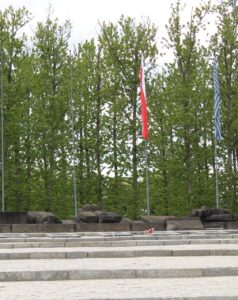
Two days later, we wrote the following lament:
… and then we walked out…
Never again.
It happened, therefore it can happen again. Primo Levi.
Grateful to witness but shameful to know it.
We witness and remember.
We cannot do more, we cannot do less.
When words are inadequate, Lord, hear our prayer.
How do I pray here?
Tiny shoes belong on tiny feet.
Not here in the rubble,
Scattered on the heap.
The eleventh commandment: Never be a bystander.
I believe in God even when God is silent.
God, forgive us our inhumanity.
We need the community to help us
Through the difficult
And the tragedies this life brings us.
I don’t know how to do theology after Auschwitz.
Rest remains elusive.
May our wounds/our pain ascend.
and touch the wounds and pain that is God’s.
Amen.