Reflection: Shoah and its Aftermath
by Rachel Baard, Assistant Professor of Theology and Ethics
The 2026 Shoah and its Aftermath Travel Seminar has come to an end. This seminar had been years in the making and involved months of planning by myself and my colleague Dorothee Tripodi. Apart from arranging site visits and setting up appointments with speakers and dignitaries in Germany and Poland, a surprising amount of our time went into creature comforts: convenient flight routes, comfortable sleeping arrangements, restaurant bookings, and special accommodations for those who have physical ailments. On our return journey those special accommodations even involved some of us being lifted up to the airplane with a mechanical lift at Frankfurt Airport, which brought some hilarity, some fear of heights, and a recognition of the frailty of our bodies. It is also the frailty of the human body, although in a much deeper and more serious sense, that is central to what we witnessed on this trip.
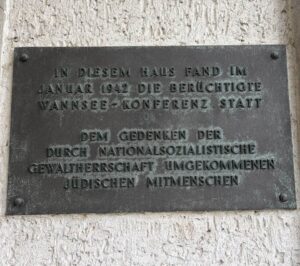
The two places that bookend my own experience of this journey are the site of the infamous Wannsee Conference in the outskirts of Berlin, and the place that most notoriously symbolizes the outcome of that conference: Auschwitz-Birkenau. The house at Wannsee is beautiful, situated in a tranquil setting close to the lake, amidst tall trees, surrounded by the sound of birds. Inside the house our guide took us through rooms with graphs and photographs that tell the story of the meeting that concluded with the “Final Solution,” a systematic approach to the genocide of Europe’s Jewish population. One of the photographs remains etched in my mind: an elderly Jewish shopkeeper, Richard Stern, with his World War I medals on his coat, defending his shop against Nazi thugs. The medals signal his rightful claim of belonging to the German nation, a visible protest against an ideology that denied his citizenship and instead saw him as a problem, part of a question: the “Jewish Question.”
This is no innocent phrase, but a prerequisite for mass murder. We usually cannot kill those whose humanity we recognize. But when human beings are turned into chattel, into animals or things, into a problem, a question in search of a solution, the path to genocide lies wide open. So when the Nazis gathered at that beautiful house outside Berlin on January 20, 1942, they did not see themselves as planning something shameful, but as solving a problem, providing a Final Solution to the “Jewish Question.”
I often remind my students that monotheism demands that we view evil not as a separate force outside ourselves, but as the distortion of God’s good creation, and more specifically in the case of moral evil, the demonic distortions that come from our own hearts. This is also why evil often appears desirable to us, beautiful even, or good. In his essay, After Ten Years, written on New Year’s Eve 1942, the German martyr-theologian Dietrich Bonhoeffer wrote of the first ten years of Nazi rule as a huge “masquerade of evil” that has appeared “in the form of light, good deeds, historical necessity, social justice.” Did those who were gathered at Wannsee imagine themselves to be morally upright men embarking on an unpleasant but necessary task for the sake of the “Greater Good”? Based on all available evidence, it seems that they did. And that is what makes that house at Wannsee so chilling. For on the other side of that tranquil setting lies Auschwitz-Birkenau, where evil drops all pretense of serving the “Greater Good” and simply serves up death on an unimaginable scale.
It is not really possible to tell others what Auschwitz-Birkenau is like. To walk into Auschwitz with its famous sign, “Arbeit macht frei” (“Labor Liberates,” a bitter lie if there ever was one), into the spaces where people were forced to stand outside in freezing rain, starving due to meager rations, sleeping 10 to a bunk in a room that resembles a damp cellar, is to enter into a place removed from the world, a place where normality will never exist again. To walk into Birkenau, the death camp that was built next to Auschwitz for the single purpose of killing human beings, to see the place where people got off the trains to be selected for work or immediate death, to see the ruins of crematoriums, is to step onto sacred ground, because it is for all practical purposes a graveyard. There the eerie silence still carries the whispers of the dead.
In Auschwitz we walked past exhibits of brushes and combs, shoes, pots and pans, crutches and walking sticks – the kind of items that support our bodies, our lives. These items signal vulnerability, the simple humanity of each of the human beings whose lives ended in that horrible place. They continue to bear silent witness to the people who once owned those items, to the lives they lived, to the frailty of their bodies. Those combs and shoes were objects in service to the holy work of living.
The Jewish philosopher Emmanuel Levinas reminds us that the “face” of the other person, their vulnerability and mortality, is where we encounter the Divine. When we stand before the frail bodies of other human beings, or even simply before the relics that still silently witness to their lives, we stand on Holy Ground. This Holy Ground is not a place but an ethical event that occurs in the face-to-face encounter with the Other. Holiness, argues Levinas, is found in the non-violent response to the vulnerability of another human being.
Christianity’s long history of antisemitism is an abject failure to live up to that call to holiness. Our own tradition ought to call us into the recognition that the very bodies of human beings are the site of divine revelation, for did God not make all of us, and do we not confess that God even made common cause with bodily existence, and do we not practice ministries in which God cleanses and feeds bodies sacramentally? How then can we fail to recognize the holiness of the frail bodies of human beings, and our own call to a sanctification that consists of a loving and non-violent response to their very existence?
After the Shoah the cry has been, “Never Again.” But we are always at risk of repeating ourselves. Each time that we conclude that a group of human beings are a problem, a question in search of a solution, we risk repetition. Every time that we forget that the Other presents us with the face of the Holy, that their very life is a site of divine work, we risk engaging in that distorted reality that we call evil.
May we learn the right lessons from history. May we never forget. May we tread with reverence when confronted with the frail bodies of everyone around us, knowing that we stand on Holy Ground because we stand before the image-bearers of the Creator. May we remember the times when we forgot the humanity of other human beings. Never Again is not a slogan. It’s a solemn oath. May God grant us mercy to keep it.