Common Ground is Holy Ground
by Brittany Bryan
After a deeply meaningful five days in Berlin, we arrived Sunday evening in Wroclaw, Poland. Stepping out of the train station, I was immediately struck by the architectural differences between the two cities.
In Berlin (especially West Berlin), many buildings that were destroyed in WWII were rebuilt with more contemporary designs that stand at once apart and amidst the rich, complicated historical backdrop of the city. Its classical and modern architecture seamlessly intertwine, seemingly honoring history while embracing change and lending to ongoing dialogue between the past and present. In group discussions thus far, we’ve talked about how that juxtaposition of old and new highlights the importance of memory and what Bonhoeffer calls a “responsibility toward history.”
In contrast, when I stepped out of the taxi in Wroclaw, it felt like stepping back in time. The buildings looked like they’d been perfectly preserved, despite the fact that 90% of Wroclaw was destroyed during WWII and in the subsequent Soviet takeover. It was in that aftermath that the Polish people, in their newfound freedom, had to ask themselves: Who are we? Who do we want to be? Thus, rebuilding became a question of identity. Ultimately, the decision was made to rebuild and restore the city to its pre-war design. And so, the question of identity and resilience was rolling around in my mind as we began our week in Wroclaw.
We started our Monday morning off with a tour of the “Four Quarters of Mutual Respect” (thanks, Joanna!). We explored four different houses of worship that are situated within a quarter of a mile from one another: the Lutheran Church of Divine Providence, the Orthodox Cathedral of the Nativity of the Blessed Virgin Mary, the Roman Catholic Church of St. Anthony of Padua, and the White Stork Synagogue.
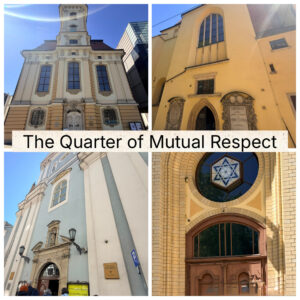
The symbolism of identity and resilience was encapsulated by all four of these religious structures, each serving as an incredibly powerful symbol of what peaceful coexistence can look like, where difference is not erased but honored. In a world often fractured along lines of political and religious identity, this shared quarter represents how religious communities can come together to foster intercultural understanding and interreligious dialogue, to build resilience and community across differences.
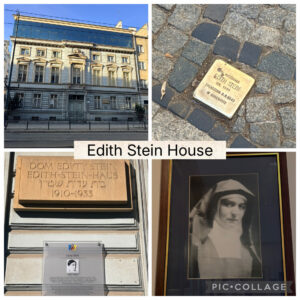
This theme continued throughout the day as we moved on to tour the family home where Edith Stein grew up, which now serves as a museum. Stein was born into a Jewish family and decided later in life to convert to Catholicism, eventually becoming a Carmelite nun. Written on one of the plaques in the exhibit was something Edith Stein herself wrote: “I am a daughter of the Catholic Church and of the Jewish nation.” Once again, the intersectionality of different religious traditions and lived experiences, this time embodied in one human, provoked thoughts of identity and resilience as we walked throughout the house. The religious juxtaposition of Judaism and Catholicism central to Stein’s life stands as a testament to the complexity of human existence, which was captured in another plaque in the exhibit: “In her desire to bring about a better understanding between Christians and Jews, Edith Stein was ahead of her time.”
Interreligious dialogue is an ongoing endeavor, and a core feature of public theology. Those of us in the MAPT program here at UPSem wrestle with questions of identity politics and meaning-making in the pursuit of justice. But some things are just really hard to make sense of, aren’t they? Religion, for many people, provides a sense of meaning and belonging, and offers answers to the questions, who are we and who do we want to be? But others would rather do away with religion altogether, and far too many people have been deeply wounded by the exclusionary practices of many religious institutions and communities.
And so, as public theologians, how do we respond to these moments in our own time? That is part of the work we are doing together here, as we learn not only from the history of the Shoah and from different religious traditions, but from one another. As our group (literally) stood at the intersection of the Four Quarters of Mutual Respect today, we discovered afresh that the pursuit of common ground is holy ground, indeed.